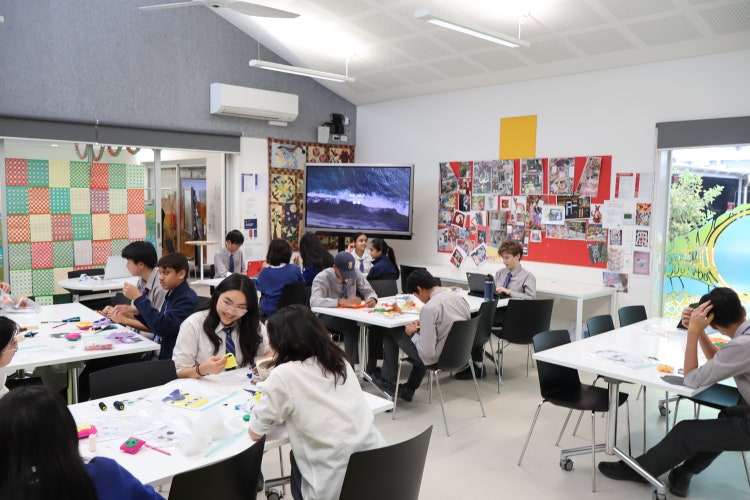
Technological and Applied Studies
Through bold thinking, creative design, and purposeful construction, Hurlstone’s Technology and Applied Studies (TAS) Faculty challenges high potential learners to achieve excellence in an ever-evolving technological world.
At Hurlstone Agricultural High School, Technology and Applied Studies (TAS) ignites creativity, innovation, and enterprise through purposeful design and hands-on learning. The TAS Faculty challenges students to think boldly and act skilfully, transforming ideas into tangible outcomes that reflect precision, problem-solving, and imagination.
High expectations underpin every aspect of TAS learning at Hurlstone. Students are encouraged to design with intent, analyse with curiosity, and evaluate with rigour across diverse contexts such as food technology, digital systems, agriculture, textiles, and design. Lessons are structured to meet the needs of all learners while extending those with high potential through enrichment, innovation challenges, and authentic learning experiences. Each unit fosters the confidence to apply design thinking, technical expertise, and sustainability principles to real-world problems.
TAS is studied by all students from Years 7–8 through the Technology Mandatory course, laying the foundation for specialised electives in Years 9–12. These pathways empower students to excel in fields such as engineering, architecture, food science, design, and emerging technologies, preparing them to lead as creative thinkers and ethical innovators in a rapidly changing world.
Stage 4
In Stage 4, students develop the foundational knowledge, creativity, and technical skill that underpin all areas of design and technology. Across the two-year Technology Mandatory course, they engage with the core contexts of Food, Materials, Engineering, and Digital Technologies, learning how design thinking transforms ideas into purposeful solutions. Students design, produce, and evaluate projects that reflect both innovation and precision, from preparing nutritious meals and constructing textile products to designing engineered systems and programming digital environments.
Through these experiences, students learn to apply the design process with rigour, researching, experimenting, prototyping, and reflecting to improve the quality and functionality of their work. Collaboration, critical thinking, and ethical awareness are central to their learning, as they explore how technology influences people, environments, and societies. Every project challenges students to plan creatively, work safely, and think sustainably while mastering the specialist tools, materials, and digital systems that shape modern industry.
These studies prepare students for the advanced design, engineering, and technology pathways offered in Stage 5 and senior courses. The creativity, problem-solving, and applied innovation developed in Stage 4 provide a strong foundation for future success in fields such as architecture, product design, food science, and computer engineering. At Hurlstone, Technology and Applied Studies nurtures the curiosity, craftsmanship, and confidence that define lifelong learners and future leaders in an evolving technological world.
Food Technology
In this unit, students explore the science, creativity, and precision behind food production and preparation. By studying the properties and characteristics of ingredients, they learn how to combine them in balanced, sustainable, and innovative ways to sustain human life. The focus on crepes allows students to develop practical expertise in food safety, nutrition, and presentation while understanding how culture, technology, and environment influence what and how we eat. Students are challenged to think critically about food choices and their broader impact on society and the environment. They investigate the science of cooking (including the chemical and physical changes that occur during preparation) and examine how technological advancements in food production and processing have shaped modern living. Each learning experience is designed to build independence, collaboration, and resilience, with opportunities for creativity and inquiry embedded at every stage. Through high expectations and differentiated challenges, students are supported to extend their potential, exploring design thinking, innovation, and ethical decision-making in real-world contexts. The unit fosters lifelong learning and equips students with the confidence, adaptability, and practical intelligence to thrive in diverse fields such as health, nutrition, food science, and sustainable design. By mastering both the science and artistry of food, Hurlstone students cultivate the creativity, skill, and ethical understanding to become innovative thinkers and leaders in a changing world.
Materials Technologies
In this unit, students explore the creative and technical possibilities of textile design, developing an understanding of how the properties and characteristics of materials influence function, aesthetics, and sustainability. Through research and experimentation, they learn to select and manipulate fabrics to achieve purposeful design outcomes, drawing connections between material science, craftsmanship, and innovation. Students apply the design process to plan, construct, and refine their own felt creature, showcasing precision, creativity, and problem-solving at every stage. As they work from concept to finished product, they develop specialist textile skills (including pattern drafting, hand-stitching, and embellishment) while producing a professional folio that documents their research, ideas, and reflections. The unit promotes independence, resilience, and collaborative learning, ensuring that all students are challenged to extend their potential through design thinking and iterative improvement. By combining artistry with technical skill, Hurlstone students develop the creativity, precision, and perseverance that underpin future success in design, fashion, and material innovation.
Engineering Technology
In this unit, students explore how scientific principles of force, motion, and energy combine with material properties to shape the behaviour and performance of engineered systems. They investigate how these concepts underpin the design and operation of machines, structures, and mechanisms in everyday life, developing a strong foundation for innovation and problem-solving. Through research, experimentation, and guided inquiry, students learn how engineering applies creative thinking and technical understanding to design solutions that are functional, efficient, and sustainable. Students apply the engineering design process to plan, test, and refine their own rubber band–powered racers, analysing how changes in materials, force, and construction influence speed and performance. Working collaboratively, they develop prototypes, record data, and evaluate results, strengthening their capacity for precision, teamwork, and critical reflection. Extension activities challenge high potential learners to explore advanced engineering concepts and alternative design strategies, deepening their analytical and creative capabilities. By designing and testing engineered systems, Hurlstone students cultivate the curiosity, resilience, and technical skill that drive success in future pathways such as engineering, robotics, and applied innovation.
Digital Technology
In this unit, students are introduced to the foundations of computer science through the creative and immersive world of Minecraft Education Edition. By leveraging a platform students already know and enjoy, the course transforms play into purposeful learning, developing computational thinking, problem-solving, and digital creativity. Students explore coding principles using Microsoft MakeCode, beginning with visual block-based programming before progressing to JavaScript, building a bridge between intuitive experimentation and formal coding literacy. Across a series of guided and self-directed activities, students design, test, and refine digital solutions within Minecraft’s virtual environment. Each lesson combines hands-on coding challenges, unplugged exercises, and creative projects that strengthen algorithmic thinking, logic, and collaboration. As they develop increasingly sophisticated builds and automations, students learn how code can be used to model systems, automate processes, and enhance efficiency — the same principles that drive real-world innovation in technology and engineering. Extension opportunities invite high potential learners to pursue independent projects that deepen their understanding of programming syntax, digital design, and computational systems. Through this integration of play, creativity, and technical skill, Hurlstone students cultivate the adaptability and curiosity essential for future pathways in computer science, game design, data analytics, and emerging technologies.
Stage 5 Elective - Industrial Technology Engineering
In Stage 5 Industrial Technology – Engineering, students at Hurlstone Agricultural High School engage in a dynamic program that blends scientific understanding, technical precision, and creative problem-solving. The course immerses students in the world of engineering design, where innovation is grounded in safety, accuracy, and experimentation. From mastering workshop protocols to applying complex mechanical and structural concepts, students learn to think, design, and operate like engineers.
Each unit builds progressively on the last. The Safety Induction establishes the foundations of safe and responsible workshop practice, ensuring every student can use tools and equipment with confidence. In Engineering Structures, students design, model, and test bridges to explore the balance between strength, efficiency, and aesthetic design. Mechanisms introduces the principles of force and motion through the construction of catapults, challenging students to apply theory through hands-on experimentation. In Alternative Energy, students examine the engineering and environmental impact of renewable technologies, connecting design thinking with global sustainability. The class elective on water bottle rockets synthesises all learning through the lens of flight and physics.
Across the course, students develop technical drawing, research, and construction skills while cultivating analytical and creative capabilities essential for the engineers of tomorrow. This program reflects Hurlstone’s commitment to excellence in STEM education, nurturing innovators who will shape the future of technology, sustainability, and applied science.
Safety Induction
In this introductory unit, students develop the essential knowledge, skills, and habits required to work safely and confidently in an engineering workshop environment. The focus is on understanding and applying the core principles of occupational health and safety, preparing students for practical work across all Stage 5 Industrial Technology – Engineering projects. Through explicit instruction, demonstration, and guided practice, students learn the correct use of personal protective equipment (PPE) and the safe operation of machinery and tools, including the disc sander, drill press, scroll saw, and a range of precision hand tools. Students complete the Onguard online safety training and testing modules, reinforcing their understanding of safe operating procedures, risk management, and workshop protocols. Emphasis is placed on developing awareness, responsibility, and respect for shared learning spaces. Practical demonstrations and teacher-led modelling allow students to observe and replicate best practice, while formative assessment ensures that every learner meets safety requirements before engaging in independent or group projects. By the end of the unit, students demonstrate their ability to identify hazards, follow correct procedures, and maintain a professional standard of conduct in the workshop. This foundational learning cultivates a culture of safety, accountability, and craftsmanship. These qualities underpin every future engineering activity at Hurlstone and align with industry standards and expectations for aspiring engineers and technicians.
Engineering Structures
In this unit, students investigate the principles of engineering structures through the design, construction, and testing of a balsa wood bridge. Working collaboratively in pairs, they apply core concepts of strength, stability, and efficiency to create a bridge that spans a 250mm gap and supports the maximum possible load relative to its mass. The project challenges students to think like engineers, including balancing structural performance with material economy, aesthetic quality, and functional design. Students undertake a comprehensive design process that includes the production of detailed folios featuring annotated truss bridge sketches, orthogonal drawings, and research into the mechanical properties of materials. Using both traditional drafting tools and digital simulation software, they model, test, and refine their bridge designs before subjecting them to load testing and analysis of structural failure. This hands-on experimentation develops their understanding of applied physics, design optimisation, and data interpretation. In parallel, students examine the Sydney Harbour Bridge as a case study, analysing its engineering innovation, social significance, and environmental impact. Through this synthesis of practical and theoretical learning, students strengthen their technical drawing, construction, and analytical skills while deepening their appreciation for how engineered structures shape communities and landscapes. This unit cultivates critical and creative thinking, precision, teamwork and capabilities that form the foundation for future pathways in civil engineering, architecture, and industrial design.
Mechanisms
In this unit, students explore the fascinating world of mechanical systems through the design and construction of a working catapult. Building on their understanding of force, motion, and energy transfer, students investigate how mechanical advantage is achieved through levers, pivots, and tension. They apply this knowledge to design, model, and build a catapult capable of launching a projectile with precision and power, integrating creativity with sound engineering principles. Students produce detailed AS1100-compliant engineering drawings, using them as a blueprint for construction. They develop accuracy and technical fluency with drafting tools and digital design platforms, ensuring their catapult meets dimensional, structural, and safety requirements. Through iterative testing and refinement, students evaluate their design for efficiency, consistency, and range, analysing performance data to identify opportunities for improvement. Throughout the project, students strengthen their understanding of mechanical design, safe workshop practice, and experimental testing, working both independently and collaboratively to manage time, resources, and processes. The unit culminates in a formal evaluation of each catapult’s functionality, performance, and craftsmanship, reinforcing the importance of precision and evidence-based design. By connecting theoretical principles with hands-on innovation, Hurlstone students cultivate the analytical, technical, and creative capabilities that underpin future success in fields such as mechatronics, robotics, and applied engineering.
Alternative Energy
In this unit, students explore the science and engineering of alternative energy systems, focusing on the operation and application of solar power. Through hands-on investigation and guided research, they learn how solar cells convert light into electricity, examining the materials, structure, and manufacturing processes that enable this transformation. Students illustrate their understanding through detailed sketches, photographs, and annotations that explain how photons activate electrons and generate current within a photovoltaic cell. Beyond the technical mechanisms, students analyse the broader environmental, social, and economic impacts of renewable energy. They evaluate the advantages and limitations of solar technology, considering its role in reducing carbon emissions, supporting sustainable living, and shaping Australia’s energy future. Using real-world data, students explore the cost-effectiveness of installing solar panels in a domestic context, calculating payback periods and energy savings to inform evidence-based conclusions. Throughout the unit, students apply scientific reasoning, research and design skills, and safe operational practices while constructing and testing small-scale solar models. This integration of theory and application fosters their understanding of sustainability, innovation, and problem-solving in engineering contexts. By investigating alternative energy systems, Hurlstone students develop the technical insight and environmental awareness essential for future pathways in renewable energy, environmental engineering, and sustainable technology design.
Class Elective
In this unit, students apply their accumulated knowledge of engineering principles to the design, construction, and testing of a water bottle rocket. Acting as both designers and engineers, they explore the forces that govern flight (lift, drag, thrust, and gravity) and use Newton’s Laws of Motion to understand and predict how these forces interact. Through this investigation, students bridge theoretical science with real-world engineering, using experimentation and data collection to measure performance and refine design outcomes. Students begin by developing engineering drawings that comply with AS1100 standards, translating conceptual ideas into precise technical plans. Guided by a design brief, they construct and test their rockets under controlled conditions, applying safe operating procedures and workshop protocols throughout the process. Flight data, including height, distance, and stability, is recorded and analysed to evaluate performance and efficiency. This unit emphasises creative problem-solving, precision, and evidence-based reasoning. Students learn to optimise design variables, manage time and resources effectively, and critically assess the relationship between structure and performance. By integrating scientific analysis with engineering practice, Hurlstone students develop the curiosity, discipline, and innovation that characterise future leaders in aerospace, mechanical engineering, and applied physics.
Stage 5 Elective - Food Technology
In Stage 5 Food Technology, students at Hurlstone Agricultural High School engage in a rigorous and creative exploration of how food shapes health, culture, and industry. The course develops students’ understanding of nutrition, food science, and the social role of food, while refining the technical and practical skills required to plan, prepare, and present high-quality food products. Through research, experimentation, and hands-on application, students learn to make informed choices that promote wellbeing, sustainability, and innovation within an evolving global food landscape.
The program begins with Food Selection and Health, where students examine the nutritional value of foods and the diverse dietary needs across the life cycle, connecting theory with the preparation of balanced and appealing meals. Food Service and Catering introduces students to the operational and creative demands of the food industry, from menu design and food preservation to the delivery of professional catering experiences. In Food for Special Occasions, students explore the cultural significance of food in celebration, producing sophisticated dishes that showcase artistry, precision, and meaning.
Across all units, students develop competence in food safety, hygiene, and presentation, alongside research, design, and evaluation skills that mirror real-world culinary and hospitality practices. This course reflects Hurlstone’s commitment to excellence in applied learning, equipping students with the nutritional literacy, creativity, and technical expertise essential for future success in food science, hospitality, health, and the culinary arts.
Food Selection and Health
In this unit, students explore the complex relationship between food selection, nutrition, and health, developing an understanding of how diet influences wellbeing across the human lifespan. They investigate the functions and sources of the six essential nutrients and examine how nutritional requirements vary with age, activity level, and life stage. Through research and analysis, students consider the physiological, cultural, and social factors that shape food choices and the implications of both undernutrition and overnutrition on personal and public health. Students explore the impact of food allergies, intolerances, and nutritionally modified products, developing awareness of how science and technology contribute to inclusive and adaptive food solutions. They also identify community and professional support networks that promote healthy eating habits and assist individuals with specialised dietary needs. Practical experiences form a central component of this unit. Students plan, prepare, and evaluate a range of safe and nutritious meals that align with national dietary guidelines and meet the needs of specific groups, such as children, athletes, or the elderly. These activities reinforce the connection between nutritional theory and real-world application, promoting independence, precision, and creativity in food preparation. Through this unit, Hurlstone students cultivate the scientific literacy, critical thinking, and practical expertise necessary for future pathways in nutrition, health science, and food technology innovation.
Food Service and Catering
In this unit, students investigate the dynamic world of food service and catering, developing an understanding of the systems, skills, and standards that underpin successful food operations. They explore the structure and function of catering enterprises, from menu design to customer service, and analyse how these elements combine to deliver safe, efficient, and high-quality dining experiences. Through the study of diverse menus and service styles, students learn to plan for different contexts, audiences, and event scales (from intimate gatherings to large functions) with a focus on aesthetic presentation, time management, and teamwork. Students examine the causes of food deterioration and spoilage, learning to apply the scientific principles of food preservation and storage to maintain quality and safety. This theoretical knowledge is reinforced through practical experiences that mirror authentic industry practice. Working collaboratively, students design, plan, and prepare appealing food products and menus suitable for catering events, demonstrating creativity, precision, and professional conduct throughout the process. The unit culminates in a group practical and folio assessment, where students integrate their culinary and organisational skills to deliver a catering solution from concept to presentation. Through this experience, Hurlstone students gain valuable insights into the operational, technical, and creative dimensions of the food industry, building foundational expertise for future study and careers in hospitality, food science, and event management.
Food for Special Occasions
In this unit, students explore the cultural, social, and symbolic significance of food in marking life’s milestones and celebrations. They investigate the diverse ways in which individuals and communities use food to express identity, tradition, and belonging, studying special occasions across cultures, religions, and historical contexts. Through this exploration, students gain a deeper appreciation for how food brings people together, communicates meaning, and reflects shared values within families and societies. Students apply their learning through a series of practical experiences that develop advanced skills in food preparation, handling, and presentation. Working both individually and collaboratively, they design and produce a range of dishes and decorative items suited to different celebrations, from formal events to personal milestones. Emphasis is placed on creativity, technical accuracy, and aesthetic refinement, as students consider factors such as theme, audience, and cultural appropriateness in their menu planning. The unit culminates in a Food for Special Occasions Practical (Cake Showcase) and Folio, where students demonstrate precision, innovation, and presentation excellence in their final product. This celebratory assessment highlights their mastery of food design, artistry, and professional practice. Through this unit, Hurlstone students refine the practical and creative skills that underpin careers in food design, hospitality, and event catering, while developing an enduring appreciation for food’s power to connect and celebrate communities.
Stage 5 Elective - Computing Technology
In Stage 5 Elective Computing Technology, students at Hurlstone Agricultural High School develop the knowledge, creativity, and technical expertise to design, build, and evaluate digital systems that shape the modern world. The course immerses students in the evolving fields of data analytics, automation, and software development, equipping them with the computational thinking and problem-solving skills that underpin innovation across industries. Through practical, project-based learning, students move from understanding how data drives decision-making to creating intelligent systems and interactive digital experiences.
In Enterprise Information Systems: Analysing Data, students learn how information is collected, stored, and visualised in digital environments. They use professional tools such as spreadsheets and databases to organise and interpret data, developing precision and analytical insight. Software Development: Building Mechatronic and Automated Systems introduces students to the integration of mechanical and digital technologies, where they design and program Arduino-based models that respond to real-world inputs. In Software Development: Creating Games and Simulations, students apply programming logic and creative design to develop engaging, ethical, and purposeful games that reflect innovation in entertainment and simulation technologies.
Across all units, students apply iterative design processes, collaborate effectively, and reflect on the ethical implications of technology in society. This course builds digital fluency, creativity, and critical thinking which prepares Hurlstone students to be adaptive innovators and ethical leaders in future pathways such as computer science, robotics, data analytics, and software engineering.
Enterprise Information Systems: Analysing Data
In this unit, students explore the dynamic world of enterprise information systems and the critical role that data plays in decision-making, innovation, and communication. They examine how technological advancement has transformed the ways data is collected, stored, and secured, tracing the evolution of computing from manual systems to contemporary digital platforms. Through this study, students develop an appreciation for how data-driven insights underpin effective business operations and inform strategic choices in modern enterprises. Students learn to acquire, represent, analyse, and visualise structured data, developing practical fluency in industry-standard tools such as Microsoft Excel and Microsoft Access. They construct and manage databases, apply spreadsheet formulas, and create visual representations of data to identify patterns and relationships. Through guided tasks and independent projects, students strengthen their technical capability while enhancing their ability to interpret and communicate information clearly and accurately. The unit culminates in an in-class examination and database management task, where students demonstrate their proficiency in digital data manipulation, analysis, and security principles. By understanding how information systems operate across industries, Hurlstone students develop critical analytical, organisational, and problem-solving skills that form a foundation for future pathways in computing, data science, business analytics, and information technology management.
Software Development: Building Mechatronic and Automated Systems
In this unit, students explore the principles of software development through the study and creation of mechatronic and automated systems that combine mechanical, electronic, and digital components. They investigate real-world examples of automation (from robotics to industrial control systems) to understand how innovation and enterprise have shaped the evolution of mechatronic technologies. This contextual study helps students appreciate both the complexity and the transformative potential of automated systems in modern industries. Working collaboratively, students apply iterative design and development processes to define problems, plan solutions, and build functioning prototypes using Arduino microcontrollers. They design, code, and test automated systems that perform specific tasks, documenting each stage of their process through a detailed Mechatronics Folio. Emphasis is placed on teamwork, project management, and evaluation, as students analyse how programming logic, sensors, and mechanical design interact to achieve efficient and responsive automation. Throughout the project, students develop skills in coding, circuit assembly, testing, and documentation, while refining their ability to evaluate and improve their designs based on evidence and performance data. The unit culminates in the presentation of a working robotic model, showcasing students’ creativity, precision, and problem-solving capacity. By merging digital and physical technologies, Hurlstone students gain a deep understanding of the innovation driving Industry 4.0 and develop the technical and collaborative skills that prepare them for future pathways in robotics, engineering, and software design.
Software development: Creating Games and Simulations
In this unit, students explore the creative and technical processes behind game and simulation development, applying programming and design skills to produce their own interactive digital products. They examine how innovation, enterprise, and automation have shaped the evolution of gaming (from early arcade systems to immersive virtual environments) and analyse how simulations are used beyond entertainment, including in education, science, and industry. This exploration fosters an appreciation of games and simulations as powerful tools for communication, creativity, and problem-solving. Students learn to define problems, plan solutions, and develop programs using iterative software development methods. Working independently, they design, code, and evaluate a fully functional game that reflects both technical competence and imaginative design. They develop proficiency in core programming concepts such as variables, control structures, and event-driven logic, while refining their ability to create engaging user experiences through effective interface design and visual storytelling. Ethical and responsible digital practice forms a key focus, with students applying safe and secure behaviours in all stages of development. The unit culminates in an individual Game Design Assessment Task, where students demonstrate their programming expertise, creative vision, and capacity for evaluation and refinement. Through this fusion of art, logic, and innovation, Hurlstone students cultivate the digital fluency, discipline, and entrepreneurial thinking essential for future success in game design, software engineering, and interactive media development.
Year 11 Preliminary HSC Hospitality
The Preliminary Hospitality Course at Hurlstone Agricultural High School provides students with an authentic introduction to one of Australia’s most dynamic and fast-growing industries. Grounded in real-world application, the course combines technical training, industry awareness, and employability skills to prepare students for meaningful participation in the workforce and further study within the Vocational Education and Training (VET) framework. Students learn through hands-on experiences that replicate industry standards, developing both the competence and confidence required to work safely, ethically, and professionally in commercial food environments.
Central to the course is the study of hygiene and food safety, where students gain the knowledge and skills to manage food preparation, storage, and service in compliance with legislative and organisational requirements. Through the unit Use Hygienic Practices for Food Safety and Participate in Safe Food Handling Practices, students learn to identify hazards, control contamination risks, and apply food safety programs that protect public health. These practices are reinforced through practical, industry-aligned tasks that reflect the expectations of contemporary hospitality workplaces.
Beyond technical skill, the course develops transferable capabilities essential for holistic growth, including teamwork, time management, customer service, problem-solving, and personal responsibility. Students learn to communicate effectively, work collaboratively under pressure, and deliver quality outcomes with professionalism and care.
The Preliminary Hospitality Course at Hurlstone reflects the school’s vision for excellence through applied learning, empowering students to connect their academic understanding with authentic vocational pathways. By blending precision, service, and creativity, students build the foundation for future success in hospitality, tourism, and broader industries where adaptability, initiative, and leadership are key.
Use Hygienic Practices for Food Safety and Participate in Safe Food Handling Practices
In this foundational unit, students develop the essential knowledge and practical skills required to maintain hygienic and safe food-handling practices in hospitality environments. They learn how correct hygiene procedures underpin every aspect of the food industry, from storage and preparation to display, service, and disposal, ensuring the health and wellbeing of customers, colleagues, and themselves. Emphasis is placed on understanding how contamination occurs, the conditions that encourage the growth of harmful bacteria, and the critical control measures that prevent food-borne illness. Through both theoretical study and hands-on application, students apply industry-standard food safety protocols aligned with legislative and organisational requirements. They learn to identify potential hazards, implement control strategies, and follow food safety programs that reflect commercial best practice. Practical sessions reinforce the importance of personal hygiene, safe work practices, and effective cleaning procedures in maintaining high professional standards. By engaging in authentic industry scenarios, students develop confidence and competence in the safe handling of food and beverages, laying the foundation for all future work in the hospitality sector. This unit instils professionalism, accountability, and precision. These qualities that reflect Hurlstone’s commitment to excellence in vocational education and that prepare students for success in food and beverage service, commercial cookery, and broader careers in the hospitality and tourism industry.
Year 11 Preliminary HSC Engineering
In the Preliminary HSC Engineering Studies course, students at Hurlstone Agricultural High School explore how scientific, mathematical, and technological principles combine to solve complex real-world problems and shape the modern world. The course provides a strong foundation in engineering theory, design, and application, guiding students to understand how innovation drives progress across industries, including transport, manufacturing, and biomedical technology. Through both practical and theoretical study, students learn to think critically, design creatively, and analyse systems with precision and purpose.
The course begins with Engineering Fundamentals, where students investigate the core scientific and mathematical concepts that underpin all engineering fields. They explore how material properties, forces, and structures interact to produce efficient and functional designs. In Engineered Products, students apply these principles to everyday technologies, examining how components and processes transform ideas into practical, sustainable solutions. Braking Systems builds on this foundation, introducing mechanical analysis, testing, and innovation in safety and performance systems, while Biomedical Engineering extends students’ understanding to the intersection of technology and human health, exploring how research and design are improving lives around the world.
Throughout the course, students apply mathematical reasoning, graphical communication, experimentation, and teamwork to develop engineering solutions that reflect both technical excellence and social responsibility. The Preliminary Engineering Studies course reflects Hurlstone’s commitment to nurturing analytical, ethical, and forward-thinking problem-solvers who will lead future innovation in engineering, design, and applied science.
Engineering Fundamentals
In this foundational unit, students develop a broad understanding of the core principles that underpin engineering practice, establishing the essential knowledge and skills that support all future study in the discipline. The focus is on exploring how scientific, mathematical, and technological concepts combine to shape engineered materials, systems, and products that meet human needs. Students investigate the properties and structures of materials, analysing how these influence performance, application, and innovation in the engineering field. Through practical and theoretical learning, students examine the relationships between materials, components, and processes, using real-world examples to illustrate how engineering design transforms ideas into functional solutions. They apply mathematical reasoning, graphical representation, and scientific inquiry to solve engineering problems, developing precision in analysis and communication. Students also explore the impact of technological advancement on society and the environment, considering how innovation drives progress while shaping social, cultural, and ethical outcomes. By understanding both the technical and human dimensions of engineering, students begin to view engineers as creative problem-solvers and responsible innovators. This unit forms the cornerstone of the Preliminary Engineering Studies course, equipping Hurlstone students with the conceptual understanding, analytical skill, and curiosity needed to approach complex engineering challenges with confidence, creativity, and purpose.
Engineered Products
In this unit, students investigate the design, function, and development of engineered products, exploring how innovation transforms everyday objects into efficient, reliable, and user-centred technologies. Using familiar products such as kettles, power tools, lawnmowers, and motor vehicles as case studies, students examine the materials, components, and processes that bring engineered systems to life. This inquiry-based approach allows students to understand how engineering integrates scientific principles, mathematics, and design thinking to solve practical problems and improve quality of life. Through analysis and experimentation, students develop their ability to apply mathematical, scientific, and graphical methods to evaluate product performance and efficiency. They learn to communicate their findings through written, oral, and visual formats, including engineering reports and technical drawings that reflect professional standards. The unit also emphasises teamwork and collaboration, with students engaging in group investigations that mirror the multidisciplinary nature of real-world engineering projects. Students consider the social, environmental, and technological dimensions of engineering innovation, evaluating how new materials and production methods influence sustainability, accessibility, and consumer behaviour. By critically analysing engineered products, Hurlstone students gain insight into the dynamic interplay between design, technology, and society, developing the analytical and collaborative skills that form the foundation for future pathways in product design, mechanical engineering, and industrial innovation.
Braking Systems
In this unit, students explore the engineering principles behind braking systems, one of the most critical applications of mechanical design and innovation. Focusing on systems such as band brakes, drum brakes, disc brakes, anti-lock braking systems (ABS), and regenerative braking technologies, students investigate how friction, force, and energy transfer combine to achieve controlled motion and safety in mechanical and automotive systems. Through this study, they develop an appreciation for the precision and reliability required in engineering systems that protect lives and enhance performance. Students apply mathematical, scientific, and graphical methods to analyse braking efficiency, energy conversion, and system response under varying conditions. They explore how materials, components, and manufacturing processes influence design choices and performance outcomes, integrating theory with practical experimentation and testing. Using technical drawing and digital tools, students communicate their findings and design concepts through professional engineering reports and visual representations. Collaborative problem-solving is a key focus, as students work both independently and in teams to model, test, and evaluate braking mechanisms. The unit also highlights technological evolution, tracing innovations from traditional mechanical brakes to modern electronic and regenerative systems that improve energy efficiency and sustainability. By examining braking systems as complex, interdependent technologies, Hurlstone students deepen their understanding of engineering analysis, design optimisation, and innovation. Students develop the technical rigour, teamwork, and ethical awareness essential for future pathways in mechanical, automotive, and systems engineering.
Biomedical Engineering
In this unit, students are introduced to the cutting-edge field of Biomedical Engineering, where innovation in materials science, mechanics, and technology intersects with medicine to improve human health and quality of life. They explore how engineering principles are applied to the design and development of life-changing products such as artificial joints, prosthetic limbs, surgical instruments, wheelchairs, imaging technologies like MRI, and medical implants including bionic ears and heart valves. This study reveals the vital role engineers play in advancing healthcare through creativity, precision, and ethical responsibility. Students investigate the materials and manufacturing processes used in biomedical applications, analysing their mechanical, chemical, and biological properties. They apply mathematical principles to understand the forces, moments, and simple machines that underpin biomechanical function, and use three-dimensional drawing and modelling techniques to visualise and communicate design concepts. Through guided research and practical exercises, students evaluate how engineering solutions are developed to meet human needs safely, effectively, and sustainably. The unit also considers the technological, social, and environmental implications of biomedical innovation, from accessibility and cost to ethics and long-term impact on society. By examining how research and development in this field continue to transform lives, Hurlstone students gain insight into the profound potential of engineering to serve humanity. This unit inspires curiosity, empathy, and critical thinking, preparing students for future study and careers in biomedical engineering, medical technology, and applied sciences.
Year 12 HSC Hospitality
In the HSC Hospitality Course, students at Hurlstone Agricultural High School refine their technical expertise, service precision, and professional conduct in preparation for work in the dynamic hospitality industry. Building on the foundations established in the Preliminary course, this stage deepens students’ practical knowledge of food and beverage operations, emphasising quality service, customer engagement, and adherence to industry standards. Through hands-on learning, students apply their skills in authentic contexts that mirror commercial café and restaurant environments.
In Prepare and Serve Non-Alcoholic Beverages, students learn to produce and present a diverse range of teas, brewed coffees, and specialty drinks. They focus on ingredient selection, preparation techniques, and aesthetic presentation while upholding strict hygiene and safety standards. In Prepare and Serve Espresso Coffee, students advance these skills by mastering the operation of commercial espresso machines and grinders, refining the craft of extraction, milk texturing, and drink presentation. They also develop product knowledge and customer service skills essential to professional coffee preparation.
Together, these units cultivate the precision, efficiency, and professionalism required in modern hospitality. Students learn to deliver consistent, high-quality service while managing time, teamwork, and customer satisfaction. The HSC Hospitality Course reflects Hurlstone’s commitment to excellence in vocational learning, empowering students with industry-recognised competencies and transferable skills that prepare them for success in hospitality, tourism, and the broader service economy.
Prepare and Serve Non-Alcoholic Beverages
In this unit, students develop the professional knowledge and technical skills required to prepare and serve a variety of non-alcoholic beverages to industry standards. They learn to select appropriate ingredients, equipment, and preparation methods to produce high-quality drinks that meet customer expectations for flavour, presentation, and consistency. The unit introduces a range of beverage types, including specialty teas, brewed coffees, smoothies, juices, and blended drinks, allowing students to appreciate the artistry, precision, and service focus that define excellence in hospitality. Practical training emphasises hygiene, efficiency, and customer care, as students follow standard recipes and operating procedures to create beverages in both simulated and authentic service settings. They develop an understanding of beverage characteristics, garnishing techniques, and the importance of temperature control, all while reinforcing safe and sustainable work practices. This unit highlights the intersection of technical competence and customer experience, teaching students that quality service is as much about professionalism, communication, and presentation as it is about product preparation. Through these experiences, Hurlstone students build the confidence and expertise to work effectively in cafés, restaurants, and catering environments, while also cultivating transferable skills in teamwork, attention to detail, and time management that prepare them for success across the wider hospitality industry.
Prepare and Serve Espresso Coffee
In this unit, students acquire the specialised skills and knowledge required to prepare and serve espresso coffee to commercial industry standards. They learn to extract, texture, and present espresso beverages using professional espresso machines and grinders, developing both the technical precision and sensory awareness essential to high-quality coffee service. Students explore the origins, varieties, and characteristics of coffee beans, gaining an understanding of how grind size, water temperature, and extraction time influence flavour and aroma. Practical training focuses on the complete workflow of coffee preparation, from advising customers and taking orders to selecting and grinding beans, calibrating equipment, and producing consistent espresso-based drinks such as cappuccinos, lattes, and macchiatos. Students also learn the correct procedures for cleaning, maintaining, and safely operating espresso machines and grinders, recognising when specialist servicing is required. The unit emphasises professionalism, efficiency, and customer engagement, encouraging students to refine both their technical and interpersonal skills. By mastering the craft of espresso preparation, Hurlstone students develop confidence in a core area of the hospitality industry that demands excellence, consistency, and creativity. These competencies not only prepare students for roles in cafés and restaurants but also strengthen transferable skills in quality control, time management, and customer service.
Year 12 HSC Engineering
In the HSC Engineering Studies course, students at Hurlstone Agricultural High School extend their understanding of how engineering shapes and sustains the modern world through the design, analysis, and innovation of complex systems. Building on the foundational principles developed in the Preliminary course, Year 12 students explore advanced fields of engineering (civil, transport, aeronautical, and telecommunications) each highlighting the powerful intersection of science, mathematics, creativity, and human need.
In Civil Structures, students analyse and apply principles of mechanics, materials, and design to create and test model bridges, developing an understanding of how engineering ensures the safety and durability of the built environment. Transportation examines the evolution of personal and public transport systems, with students investigating modern innovations such as electric vehicles, high-speed rail, and automated systems that connect and sustain societies. In Aeronautical Engineering, students study the science of flight and explore how design, materials, and human error contribute to both technological advancement and engineering accountability. Finally, Telecommunication Engineering introduces the systems that underpin global communication, from early analogue technologies to modern digital and satellite networks, showcasing the role of engineers in building an interconnected world.
Throughout the course, students engage in research, experimentation, technical reporting, and collaborative design projects, mirroring professional engineering practice. They develop problem-solving, communication, and evaluative skills that prepare them for tertiary study and careers across the STEM spectrum. The HSC Engineering Studies course at Hurlstone reflects the school’s vision of cultivating innovative, ethical, and forward-thinking problem-solvers.
Civil Structures
In this unit, students investigate the principles and practices of civil engineering, one of the most essential and enduring branches of the profession. They explore how engineers design, construct, and maintain the physical structures that shape modern society, from bridges, roads, and dams to public spaces and buildings. Through the study of historical and contemporary examples, students develop an appreciation of how innovation, material science, and environmental awareness have influenced the evolution of civil structures over time. The unit combines analytical investigation and practical design, allowing students to apply theoretical knowledge to authentic engineering challenges. In Part A, students complete an Engineering Report that traces the development of bridge design over the past 250 years, comparing major systems in terms of materials, forces, and performance. This research task cultivates advanced skills in technical analysis, evaluation, and professional communication. In Part B, students work collaboratively to design and construct a model bridge using pine timber, applying mathematical and scientific principles to achieve maximum strength-to-weight efficiency. Their structures are tested to failure, providing a hands-on understanding of load, stress, and optimisation in design. Through this rigorous combination of theory and practice, students develop competence in technical drawing, data interpretation, experimentation, and teamwork. The Civil Structures unit exemplifies the applied nature of engineering studies at Hurlstone — fostering precision, creativity, and problem-solving in students who aspire to contribute to the infrastructure, innovation, and sustainability of the built environment.
Transportation
In this unit, students explore the field of transportation engineering, examining how innovation in design, materials, and systems has transformed the way people and goods move across the world. They investigate the infrastructure, vehicles, and operations that underpin different modes of transport (including road, rail, water, air, and emerging technologies) and consider how engineering enables the efficiency, safety, and sustainability of modern transport networks. Students select and research a significant innovation in personal or public transport that has emerged within the past 50 years, such as the development of electric and hybrid vehicles, high-speed rail systems, autonomous trains, or advanced tollway designs. Their research culminates in a professional presentation that analyses the historical development, engineering materials, environmental implications, structural requirements, and economic factors associated with their chosen innovation. Students also evaluate the social and environmental impacts of transport systems and explore potential future advancements in the field. This unit integrates engineering analysis, communication, and design thinking, requiring students to synthesise technical information and present it in a clear, professional format using digital media. By investigating how transport systems evolve through creativity and necessity, students gain insight into the engineering challenges that shape mobility, infrastructure, and sustainability in the 21st century. The Transportation unit strengthens Hurlstone students’ capacity to think critically, research effectively, and apply engineering principles to global issues that connect technology, people, and progress.
Aeronautical Engineering
In this unit, students examine the fascinating and complex world of aeronautical engineering, exploring the science, design, and innovation that make human flight possible. They investigate how engineers develop, construct, and operate a wide range of aircraft, from recreational planes and helicopters to spacecraft and military aviation, and consider how advancements in materials, aerodynamics, and propulsion have shaped the evolution of modern aviation. Through this study, students gain a deep appreciation for the precision, creativity, and responsibility that define the aeronautical engineering profession. A major focus of the unit is the analysis of engineering failure, where students research a significant aviation or structural disaster from the past 25 years that resulted from design or mechanical failure. They examine the technical and human factors that contributed to the event, including material selection, load distribution, fatigue, and design principles. Students present their findings through a comprehensive written report and a multimedia oral presentation, analysing the causes of failure and reflecting on how such incidents have led to improvements in safety standards, materials science, and engineering practice. This unit integrates engineering theory, investigative research, and ethical reflection, encouraging students to think critically about the balance between innovation and safety. By exploring both the triumphs and failures of the aviation field, Hurlstone students develop analytical rigour, professional communication, and an understanding of how engineering accountability drives progress. The Aeronautical Engineering unit exemplifies the discipline’s spirit of inquiry, preparing students for future study and careers in aerospace, mechanical, and structural engineering.
Telecommunication Engineering
In this unit, students explore the rapidly evolving field of telecommunication engineering, a discipline that underpins how people, communities, and nations connect in the modern world. They investigate how engineers design, develop, and maintain systems that transmit information through electrical signals and electromagnetic waves, examining technologies ranging from traditional telegraph and radio systems to modern fibre optics, satellite communication, and the Internet. Through this study, students gain an appreciation for the complexity and global significance of the networks that make instant communication possible. Students analyse the scientific and technological principles that enable telecommunication, including wave transmission, signal modulation, and data encoding. They examine the materials, components, and infrastructure involved in creating reliable communication systems, and consider how advances in digital and wireless technology have revolutionised how society shares information. By studying historical developments alongside emerging innovations, students trace the progression from early analogue methods to high-speed digital networks that drive contemporary life. Practical learning experiences and research projects allow students to apply theoretical understanding to real-world examples such as mobile phone networks, radio broadcasting, and satellite systems. They evaluate the social, environmental, and ethical implications of global connectivity, including issues of accessibility, sustainability, and data security. The Telecommunication Engineering unit highlights how creativity, precision, and responsibility intersect in the design of technologies that connect people across distance. Through this exploration, Hurlstone students develop analytical and communication skills essential for future pathways in electrical, software, and network engineering, as well as in emerging fields of digital and information technology.
Support for High Potential Learners
The TAS Faculty at Hurlstone recognises and extends students with high potential in creativity, innovation, and applied problem-solving. Through advanced design challenges, explicit teaching, and enrichment opportunities, students are encouraged to think critically, take intellectual risks, and pursue excellence across food, materials, engineering, and digital technologies. Personalised feedback and differentiated pathways ensure that all learners are both supported and stretched, developing mastery through exploration and refinement. If your child shows high potential in design, technology, or applied innovation, contact us to learn how our High Potential and Gifted Education (HPGE) programs in TAS can help them thrive as future creators, engineers, and designers.
Contact us
Have a question for our TAS Faculty?
Our friendly office team can help you get in touch.
Contact us
Find out about our approach to learning and supporting students to progress.
Learn about local transport options and how to get here safely.